Mr. Hussein Moghaddam, Senior Energy Forecast Analyst | GECF | Energy Economics and Forecasting Department
Japan is one of the top five developed economies in the world, and its advanced industries and large population require a vast amount of energy. Significantly, this island on the shore of the Pacific Ocean lacks fossil fuels reserves, in particular, natural gas. Historically, Japan has not been self-sufficient in terms of its energy needs, depending heavily on imports of fossil fuels (Figure 1).
.jpg)
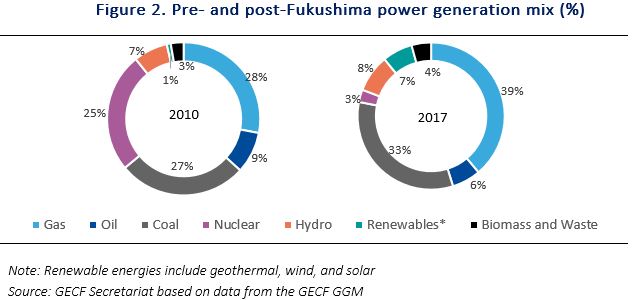
After the Fukushima incident in 2011, Japan became increasingly dependent on fossil fuels, and imports boosted reliance on coal and LNG. For instance, in the three years following the Fukushima disaster, Japan spent an additional annual average of about $30 billion, on fossil fuel imports. The government chose LNG to substitute for lost nuclear generation. As can be seen in Figure 2, while the share of gas in the Japanese electricity mix was 28% in 2010, nuclear supplied 25% of the country’s power energy. The share of gas increased to a record 42% in 2014, and delays in rebooting the nuclear fleet allowed natural gas to maintain its share, which totalled 39% in 2017, whereas nuclear supplied only 3%.
So far, in Japan eight nuclear reactors have come back into operation, and three reactors have had their operating lifetimes formally extended from 40 to 60 years. All three were due to be assessed when their original 40-year licenses expired, but it will be harder for the remaining plants to be granted the same extensions. As a result, Japan will fall short of its nuclear targets and the difference will be compensated by higher coal and gas-fired generation.
The other point about Japan is, the infrastructure and gas transportation systems belong to private energy companies, and insufficient investments have resulted in poorly connected gas transportation systems. This created some serious problems, especially after Fukushima nuclear power accident. The country faced energy shortages at a time when oil and LNG prices were particularly high. The natural gas market was liberalised and, as a result, the electricity and heating sectors were accelerated to overcome the disconnectedness of the networks.
With the implementation of the Revised Gas Business Act in 2017, the formerly regulated gas sector became competitive. Because the Japanese government aims to facilitate access to the LNG supply chain, from import terminals to distribution to end users, LNG markets were also affected. Japanese energy companies refer to the spot market to meet their domestic obligations, and for that reason prefer more flexible gas contracts.
Japan’s 2030 National Energy Plan (NEP)
Last July, Japan’s ministry for the economy, trade and industry (Meti), published a new version of the “Basic Energy Plan”, called “National Energy Plan” (NEP). This is the country’s fifth energy plan, and it was published after approval by the Japanese cabinet, and public consulting. In Japan, the government is required by law that at least every three years to re-evaluate and publish a revised energy plan. The last time the national energy plan was revised and evaluated in 2014.
The 2030 NEP, is an important document, as it is used by government departments and industry, to guide investments in the energy sector of the country. The plan is driven by safety and the ‘Three Es’: Energy security, Economic efficiency, and Environment. The 2030 NEP aims to increase domestic energy self-sufficiency to 24% by 2030, compared with 8% in 2016, and to trim emissions by 26% by 2030, and 80% by 2050, relative to 2013 levels. According to the plan, gas and coal will return to the pre-Fukushima levels, oil will drastically reduce, and nuclear energy will recover. It is expected, 22–24% of the power generation mix will be supplied by renewable energies (8.8–9.2% hydropower, 7% solar, 3.7–4.6% biomass, 1.7% wind, and 1–1.1% geothermal), which is a major shift in government policy, 20–22% will be supplied by nuclear energy, and 56% will be supplied by fossil fuels (26% coal, 27% LNG, and 3% oil). Furthermore, the country intends to cut the share of fossil fuels in its energy mix to 76% by 2030, down from 92% currently (Figure 3).
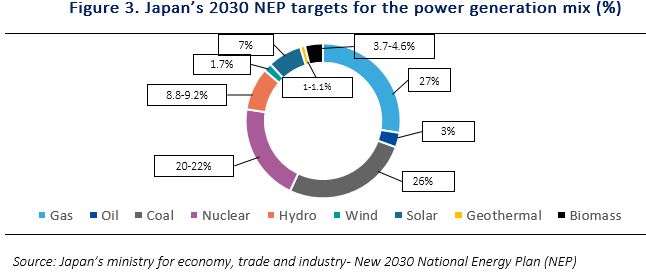
A comparison of pre- and post-Fukushima power generation mix with the 2030 NEP targets (Figure 2 and Figure 3), shows a marked shift from fossil fuels to renewables and hydro development. Although the government’s policy is still strongly supportive of nuclear restarts, public opposition remains. Restarts to date have been far slower than expected, and all reactors have faced legal challenges from local residents. The nuclear target is ambitious and can only be realized if nearly all nuclear plants are granted permission to come back online under the stricter post-Fukushima regulations, and if their lifetimes are extended beyond the standard 40 years. According to the new safety rules, before nuclear beginning to restart, operators must meet new regulatory safety standards, as well as getting approval from local Japanese governments.
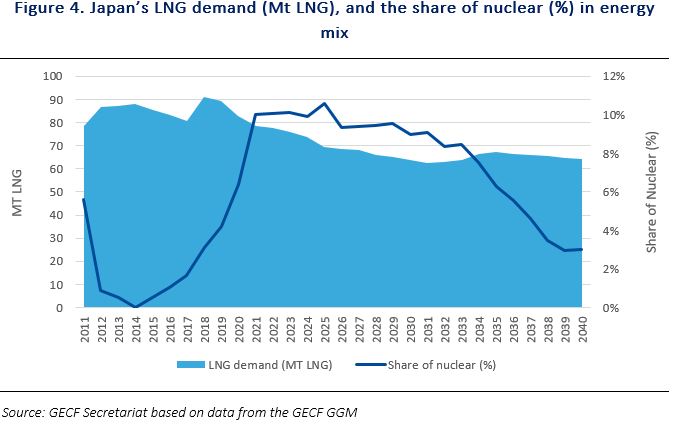
According to the GECF projections, these factors will contribute to the significant role that LNG and renewables will play in Japan’s energy mix. However, if the 2030 NEP is borne out by reality, according to the plan LNG imports will fall from 80.7 MN MT per year in 2017 to 62-64 MN MT per year by 2030, and will keep the same levels by 2040 (Figure 4). Hence, as mentioned above the share of gas in the Japanese electricity generation mix will drop to about 27% in 2030.
On the other hand, because of the energy security issues, coal will be producing 26% of Japan’s power by 2030, close the pre-Fukushima levels, but lower than the 33% that seen in 2017. During the last two years Japan opened eight new coal-fired power generations, and also aims to open another 36 coal-fired plants in the next 10 years (about 8 GW between 2015 and 2030). Actually these can supply more electricity than the 26% designated in the NEP 2030, and probably will, if nuclear fails to meet the NEP 2030 target.
To sum up, the GECF forecasts that gas demand in Japan energy mix to decline from 23% in 2017 to 19% in 2040 (from 125 bcm to about 91 bcm, accordingly). This is attributed to flat electricity demand and lower gas consumption in the power generation sector. Gas demand will be hampered by reinstated nuclear power capacity, coupled with aggressive renewables deployment that designated by the new 2030 National Energy Plan (NEP).
References:
1.GECF Secretariat based on data from the GECF GGM.
2.Japan’s ministry for economy, trade and industry.
3.Ellinas, Charles, “Japan hovers between nuclear and gas”, Natural Gas World magazine, Vol 3, Issue 16, September 2018.