Hussein Moghaddam, Senior Energy Forecast Analyst |GECF| Energy Economics and Forecasting Department
Alexander Ermakov, Energy Econometrician |GECF| Energy Economics and Forecasting Department
Natural gas plays a significant role in the energy mix of Eurasian countries, which together consumed 16% (almost 600 bcm) of the world’s gas volumes in 2017. Russia is the largest gas consumer in the region, accounting for 70% of demand. Gas consumption in Eurasia is projected to increase to 681 bcm by 2040 at an annual pace of 0.6%, slightly faster than recorded over the historical period. This minor growth in absolute terms will be driven by Russia (+47 bcm), Kazakhstan (+20 bcm), Turkmenistan (+8 bcm), Ukraine (+5 bcm), and Uzbekistan (+5 bcm). Belarus gas demand will also see a 5 bcm reduction, resulting from the commissioning of a nuclear power plant and a subsequent decrease in gas consumption in the power generation sector.
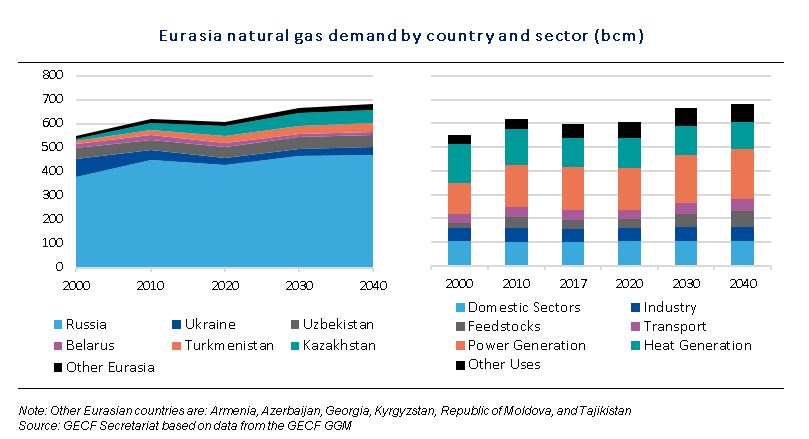
The power and heat generation sectors are the main consumers of natural gas, with respective shares of 30% (179 bcm), and 21% (125 bcm) in 2017. Additionally, the domestic sectors consumed 17% (100 bcm). In spite of relatively low gas prices and stable economic growth rates in the region, the GECF forecasts a moderate increase in gas consumption for the power generation and domestic sectors of 31 bcm and 3 bcm, accordingly. At the same time, gas demand in heat generation will decline by 10 bcm through to 2040. This will be due to high energy savings potential in the region, including energy efficiency measures, as well as the large-scale modernisation of existing CHP plants and the construction of modern gas‑fired power plants, which will have a stronger impact on gas demand during the outlook period.
Russia
Russia is the second-largest gas producer in the world. Natural gas is also the country’s main source of energy and is at the backbone of its energy balance. Russia’s gas consumption increased by 0.6%, from 379 bcm in 2000 to 422 bcm in 2017, driven by surging growth in gas demand in the feedstocks (3.6% p.a.), power generation (1.8% p.a.), and industrial (1.5% p.a.) sectors. Currently, natural gas provides around half (51%) of Russia’s energy mix. Over 2017–2040, demand is forecast to increase at an annual average growth rate of 0.5%, to almost 469 bcm in 2040. The fall in growth is mainly attributed to declining population growth. To a large extent, gas demand depends on the weather and is intricately tied to Russia’s harsh winters. The rapid expansion of natural gas use over the historical period was related to growth in power and heat generation. The power sector consumed 31% (129 bcm) of natural gas demand in 2017, compared to the 25% (106 bcm) consumed for heat generation. In 2017, the consumption of natural gas in the domestic sector was only 13% (53 bcm), but still higher than transport and feedstocks, each with 8% (35 bcm). The industrial sector, mainly the chemical and to a lesser extent the metallurgy industry, consumed approximately 39 bcm, and represented 9% of total gas demand in 2017.
Gas consumption in the power generation sector increased by 1.8% per year historically and is expected to grow slowly through to 2040 at an average annual rate of 0.7%. This sector will account for 152 bcm of gas consumed in 2040, totalling 32% of overall consumption. Slower growth over the forecast period can be attributed to the expansion of nuclear and renewables in the Russian power generation mix, as well as strengthened efficiency from new gas-fired power plants.
It is estimated that gas consumption for heat generation (space heating and cooling, water heating, lighting, appliances and cooking equipment) will drop from 106 bcm to 94 bcm. In the domestic and residential sectors, gas use will decrease to around 50 bcm of the total consumption.
Ukraine
In the period between 2000 and 2017, Ukraine’s natural gas demand fell sharply from 73 bcm to 28 bcm. The share of gas in the primary energy mix reached 29%, its lowest level since the dissolution of the Soviet Union. The overall economic recession, political crises, and ongoing military conflicts have significantly influenced both primary energy demand and gas consumption. Simultaneously, this dramatic decrease allowed Ukraine to reduce its dependency on Russian gas and to meet its needs with domestic gas production and reverse flows from Europe. Historically, the main consumers of natural gas in Ukraine were the residential, district heating (heat generation) and industrial sectors, which collectively represented 76% (22 bcm) of total natural gas demand in 2017. Over the forecast period, gas consumption is expected to increase slightly at an annual average growth rate of 0.7%, to roughly 33 bcm in 2040. This outlook is driven by a gradual economic recovery which will be offset by energy efficiency measures in heat generation and a slightly decreasing population.
Uzbekistan
Natural gas dominates Uzbekistan’s energy demand and accounted for 88% of the primary energy mix in 2017. This trend will continue over the outlook period, with gas demand rising by an average growth rate of 0.4%, from 47 bcm today, to around 52 bcm in 2040.
Uzbekistan has a population of almost 32 million and a largely energy-intensive economy. The domestic sector (especially residential) is the biggest consumer of natural gas and absorbed 17 bcm (36%) of total gas volume in 2017. Gas demand in the residential sector is highly seasonal, peaking during cold winter months as a result of increased heating requirements. Although gas prices have risen for the fourth time since 2014, the GECF expects gas consumption in the domestic sector grow to 20 bcm in 2040, and account for 39% of total gas consumption.
The power sector in Uzbekistan relies mostly on gas-fired generation, which will remain the backbone of the country’s energy system. Approximately 76% of electricity was generated form natural gas in 2017, and its share is projected to increase to 81% of the power generation mix in 2040. Uzbekenergo, a vertically-integrated monopoly, is investing considerably in fleet modernization to enhance energy efficiency. In this context, despite strong growth in electricity consumption (mostly in the commercial and residential sub‑sectors), natural gas demand in the power sector is anticipated to rise from 15 bcm in 2017 to 18 bcm in 2040.
The industrial sector consumed 6 bcm (around 12%) in 2017. A major project currently being undertaken by Uzbekneftegaz and Sasol (South Africa) is a 37,600 barrels per day gas-to-liquids (GTL) plant, which is expected to come online in 2020–2021. Another project that will boost exports of downstream refining products and petrochemicals is a gas processing and gas‑to-chemicals complex in the Surkhandarya region, which will produce polyolefins, including polyethylene and polypropylene, as well as olefins (ethylene glycol, rubber and other products). This facility may potentially feed off of the huge reserves (over 100 bcm) from the “25 Years of Independence” gas field and the O’zbekiston Mustaqillik investment block. Taking into account the aforementioned projects, the GECF expects natural gas demand in the industrial sector to remain flat as energy intensity (which is currently among the highest in the world) declines over the forecast period.