Dr. Aydar Shakirov, Gas Transportation and Storage Analyst - Gas Market Analysis Department
Gas demand in Europe is met by indigenous gas production and by gas imports. Over the last decade, gas consumption in Europe has been declining. . Domestic consumption fell from 597 Bcm in 2010 to the record low of 483 Bcm in 2014 and then rebounded to 538 Bcm in 2018.
In recent years, we have witnessed the decline in indigenous gas production in Europe. From 2010 to 2018, its gas production fell from 317 Bcm to 240 Bcm. In particular, gas production in the Netherlands decreased from 90 Bcm to 31 Bcm, which was largely driven by the legislative limitations on gas production at the Groningen gas field. The U.K. gas production fell from 58 Bcm to 40 Bcm, while in Germany it declined from 15 Bcm to 7 Bcm. Over this period, only two regional countries, namely Norway and Ireland, increased their gas production.
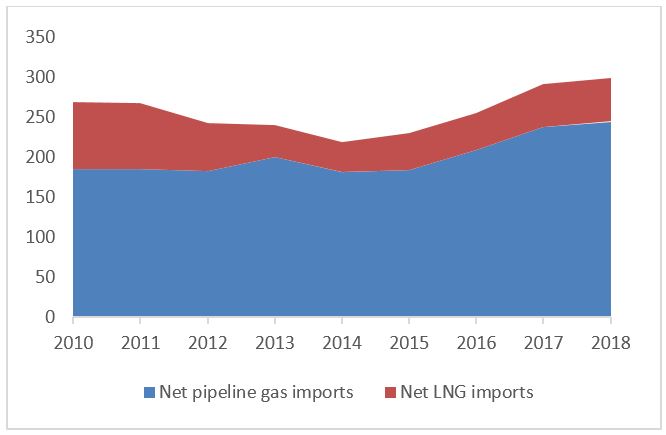
Against the backdrop of the declining indigenous gas production, gas imports in Europe has been growing. From 2010 to 2018, net gas imports rose from 269 Bcm to 299 Bcm. Over that period, the volume of gas imports fluctuated a lot, falling to 219 Bcm in 2014 and then rebounding. As a result, from 2010 to 2018, the share of gas imports in the European gas consumption rose from 46.9% to 55.4%, with the share of indigenous gas production falling from 53.1% to 44.6%.
The European gas import needs are met by pipeline gas and LNG, with pipeline gas dominating in the supply (Figure 1). In 2010-2015, net pipeline gas imports fluctuated in the range of 180 Bcm and 200 Bcm, and afterwards they grew robustly, reaching 244 Bcm in 2018. Meanwhile, net LNG imports fell from 84 Bcm in 2010 to 37 Bcm in 2014 and rebounded to 55 Bcm in 2018.
Figure 1. European gas imports by source (Bcm).
Source: GECF Secretariat based on data from Enerdata (www.enerdata.net) and BP
In 2018, net pipeline gas imports represented 82% of total European gas imports, with the share of net LNG imports reaching 18%. In comparison, in 2010 net pipeline gas and LNG imports represented 69% and 31% of total European gas imports, respectively.
The above-mentioned 2018 net pipeline gas imports at 244 Bcm represent pipeline gas supply from external countries, with intra-regional trade not taken into account. Meanwhile, various European countries import pipeline gas from regional exporters. In particular, in 2018 Norway and Denmark supplied 114 Bcm and 2 Bcm, respectively, to other European countries. Currently, only these two countries are net exporters of pipeline gas in Europe, with the Netherlands, which was a net exporter of pipeline gas for many years, becoming a net importer in 2018.
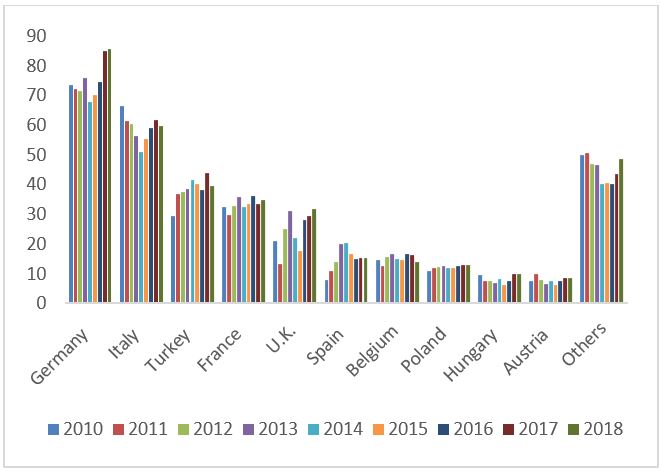
Germany, Italy, Turkey, France and U.K. are the largest import markets, accounting for 70% of pipeline gas imports in Europe. From 2010 to 2018, all top 10 importers (except Italy and Belgium) raised their pipeline gas imports, led by Germany and U.K. who each increased imports by 12 Bcm/y during the period in question (Figure 2).
Figure 2. European pipeline gas imports by country (Bcm).
Source: GECF Secretariat based on data from Enerdata (www.enerdata.net) and BP
GECF Member Countries, in particular Russia, Norway, Algeria, Libya and Iran, dominate in pipeline gas supply to Europe. These countries account for over 95% of pipeline gas supply to Europe.
In the short term, we could anticipate a further increase in pipeline gas supply to Europe, with the commissioning of new gas pipelines being one of the key driving forces.
In June 2018, commercial gas flows from Azerbaijan to Turkey started with the commissioning of the first phase of the Southern Gas Corridor (TANAP). In 2020, with the completion of the second phase of the Southern Gas Corridor (TAP), the total export capacity of the pipeline from Azerbaijan will reach 16 Bcm/y.
Besides, in 2019-2020 new gas pipelines will come from Russia with its Nord Stream 2 project (55 Bcm/y) and TurkStream project (31.5 Bcm/y). As a result, throughout the next year, 102.5 Bcm/y of new gas pipeline capacity from external countries will come online in Europe. The pipeline capacity of the three above-mentioned projects represents 19% of 2018 Europe’s gas consumption. This illustrates that European reliance on natural gas imports is strengthening and that pipeline gas will continue to play a crucial role in the energy mix of the European continent. The GECF as a key player will continue to be the backbone of the supplies of natural gas in pipeline and LNG forms to the world in general and to its European partners in particular.
Contact: Aydar.Shakirov@gecf.org