Meeting energy security in complex settings is a major challenge to the world in the future. The reliance on different fuels and the unavailability of widely applicable technology to decarbonise all the different sectors of the energy systems complicates the pathways to achieving climate goals.
Carbon dioxide will still be emitted over the coming decades. In case the world will not make a profound transition, energy outlooks produced by GECF, IEA and OPEC, project that in 2040 fossil fuels could account for two-thirds of the global energy mix with an agreement between all scenarios on the phase-out of carbon intensive fuels and a substantial increase in the role of renewables such as wind and solar. In addition, the sustainable development scenario by the IEA that simulates the way for achieving the UN Sustainable Development Goals related to energy matters, projects fossil fuels to represent 56% of the global energy mix, with natural gas representing the majority of the share.
Currently, the carbon capture technologies are on the decarbonisation pathways globally to help the world achieve climate goals. They allow for capturing the emitted CO2 from the air directly or from emission sources then storing permanently (CCS) or transporting the captured carbon and utilising it for other industrial purposes (CCUS).
Advantages of carbon capture technologies
1.Carbon mitigation
Meeting the world energy demand and fighting against energy poverty in some parts of the world requires the utilisation of carbon-intensive energy sources considering their existing infrastructure. An example would be the construction of 97.8GW of power plants in 2020 that run on coal. The largest consumer of energy, China, still relies on around 60% of its primary energy demand from coal. Implementation of large-scale CCS/CCUS projects will reduce the environmental impact of such carbon-intensive emitting fuel over the medium term until it is switched to natural gas and renewables.
2.Reduce emissions from hard-to-decarbonise sectors
Carbon capture technologies are on the list of available options to aid several industries to mitigate their emissions such as aviation, cement, and steel industry.
3.Enable viable hydrogen production
Carbon capture technologies can serve to produce low-carbon and low- cost hydrogen, compared to hydrogen production by electrolysis. Hydrogen production from natural gas supported by CCUS is half the cost of the green hydrogen .
CCUS projects in operation
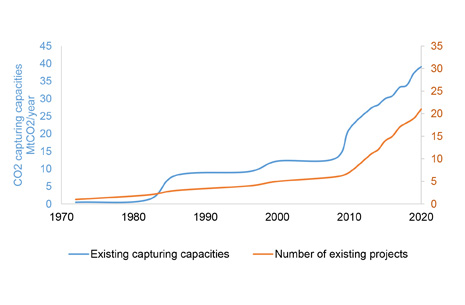
The CCUS technology was first applied 50 years ago in the U.S. to capture carbon dioxide from natural gas processing. The existing carbon capture capacities in 2020 is 39 MtCO2/year stemming from 21 projects2. The U.S. is the world leader in carbon capture implementation. The country has established 10 projects with a capacity of around 25 MtCO2/year that accounts for over 60% of existing carbon capture capacities globally.
Figure 1: Number of CCUS existing projects and capturing capacities
Source: GECF based on data from IEA.
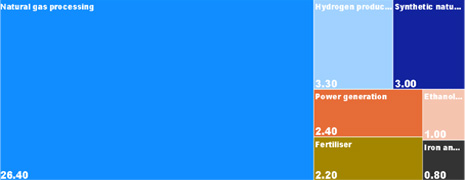
The high concentration of CO2 in produced natural gas before processing has helped to reduce the cost of capturing carbon to levels of USD 15/t CO22. Over 50% of the existing projects to remove CO2 from natural gas processing account for 26.4 MtCO2/year and 76% of them use the captured CO2 for EOR (enhanced oil recovery) activities. The facts on the implementation of the CCUS highlights its great potential to allow the production of low-carbon natural gas through the removal of the processed CO2 separated from the produced natural gas. The technology has been implemented for natural gas processing in the U.S., Saudi Arabia, Brazil, Australia, and China.
Figure 2: CO2 capturing existing capacities in 2020 by source of CO2 in MtCO2/year
Source: GECF based on data from IEA.
The fact that the majority of CCUS projects implemented in conjunction with natural gas, where the capturing cost can be as low as USD 15/tCO2 and up to USD 25 tCO2 2, indicates the fundamental role of oil and gas companies in leading carbon removal activities through their vast experience in managing carbon removal projects, managing reservoirs, oil and gas complex assets, and well integrity management, which ensures that fluids are not flowing in an uncontrolled manner through carbon injection and during carbon storage.
Government role and carbon capture
An international Delphi study on the future of carbon capture gathering experts’ opinion highlighted that technology development and integration of carbon capture technologies are among the highest impact factors that contribute to large-scale application of the technology. Besides, government regulations were agreed on by experts as of the highest impact on the development of carbon capture technologies. However, COVID-19 has strengthened the carbon mitigation momentum with governments providing capital, funding of research and supporting infrastructure.
The UK government, for example, announced the funding of GBP 0.8 billion to support carbon capture infrastructure and committed to establishing commercial frameworks to enable the establishment of a wide range of CCUS projects.
Door openers for large scale CCUS projects
Carbon management business
The creation of carbon management businesses or the addition of carbon management into the business models of oil and gas companies will foster the adaption of the technology and could be a realistic way for oil and gas companies to achieve net-zero targets. For example, Occidental Petroleum announced in January 2020 a large-scale carbon capture project to remove CO2 from the air with a capacity of 1 MtCO2/year .
Capturing from industries at a scale
Teesside project in the UK aims at supporting the net-zero target through decarbonising carbon-intensive industries on a large scale with a planned capacity of 10 MtCO2/year . Based on the GECF Global Gas Model (2020) base-case scenario, the project capacity is equivalent to around 50% of the carbon dioxide emissions from coal consumption in the UK in 2019.
Several announced and planned carbon capture projects in 2020 are expected to open the door to large-scale capturing technologies and drive the costs down. In this vein, oil and gas companies will be leading global action to reduce carbon emissions and their addition of value propositions into their business models will upscale their contribution to climate goals. These firms have the competitive advantage in terms of infrastructure and deep technical experience that will allow them to expand their business into the area of carbon management at a scale not just to capture carbon emissions from their operations, but even direct capturing from the air.
Conclusion
Natural gas - as an enabler to renewables, key supporter of clean air as a replacement for coal, and a source of new energy fuels such as hydrogen - is well positioned in today's energy mix as well as in different future energy pathways as an immediate choice to reduce emissions, ensure energy security through a reliable supply chain and abundance at a fair price. Natural gas projects when supported by carbon capture technologies that proved a success with natural gas processing in capturing 26.4 MtCO2/year will make it easier to achieve net-zero goals.
Uncertainty of government regulations has been erased by COVID-19 shock that prompted government funding and commitments to building carbon capture infrastructure. Besides, the geographic spread of the application of carbon capture technologies over the last decade, together with plans to implement large scale projects like Teesside, will practically narrow the gap to achieve emission targets.
The potential of many decarbonisation technologies and CCUS has not been fully unlocked. A newfound appreciation of their potential will enhance upscaling the contribution of natural gas in the fight against climate change.
References
1.Reuters (2020). ‘China has 250 GW of coal-fired power under development – study’, 25 June. https://www.reuters.com/article/china-coal/china-has-250-gw-of-coal-fired-power-under-development-study-idUSL4N2E20HS
2.IEA (2020). Energy Technology Perspectives 2020: Special Report on Carbon Capture Utilisation and Storage.
3.Vreys, K., Lizin, S., Van Dael, M., Tharakan, J., & Malina, R. (2019). Exploring the future of carbon capture and utilisation by combining an international Delphi study with local scenario development. Resources, Conservation and Recycling, 146, 484-501.
4.The UK Government (2020). Powering Our Net Zero Future. https://assets.publishing.service.gov.uk/ government/uploads/system/uploads/attachment_data/file/945899/201216_BEIS_EWP_Command_Paper_Accessible.pdf
5.Bloomberg (2021). Occidental to Strip Carbon from the Air and Use It to Pump Crude, 13 January. https://www.bloomberg.com/news/articles/2021-01-13/occidental-oxy-wants-to-go-green-to-produce-more-oil#:~:text=The%20globe's%20first%20large%2Dscale,and%20gas%20companies%20do%20today.
6.Net Zero Teesside (2020) https://www.netzeroteesside.co.uk/, accessed January 2021.
Mustafa Adel Amer
Research Assistant
Energy Economics and Forecasting Department