The application of the Republic of Senegal to be an observer member in the GECF was unanimously approved at the 7th GECF Summit held on 2 March 2024, in Algiers. Senegal's membership highlights that more and more countries across the world share the GECF vision to make natural gas the pivotal resource for inclusive and sustainable development, and to ensure energy security, affordability, and sustainability.
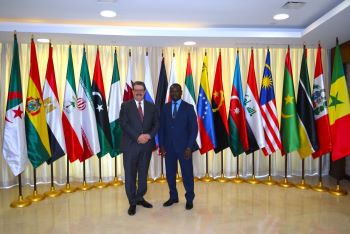
In the spirit of strengthening relationship between the GECF and Senegal, H.E. Birame Souleye Diop, Minister of Energy, Petroleum and Mining of Senegal met with H.E. Eng. Mohamed Hamel, Secretary General of the GECF on 3 June 2024 at the GECF headquarters in Doha, Qatar (Figure iii).
Historically, Senegal has been a relatively small gas market, with annual gas production and consumption averaging annually around 50 million cubic meters over the past two decades.
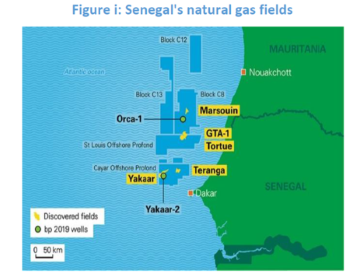
In April 2015, a major offshore gas discovery partly in Block C8 and partly in Bloc SLOP was announced, the Greater Tortue Ahmeyim (GTA) field. The gas accumulation located on the maritime border between Senegal and Mauritania is estimated to contain more than 400 bcm of potentially recoverable gas resources. In December 2018, the GTA project shareholders (BP, Kosmos Energy, Société des Pétroles du Sénégal /PETROSEN/ and Société Mauritanienne Des Hydrocarbures /SMH/), approved the Final Investment Decision (FID) for Phase 1 of this project (Figure i).
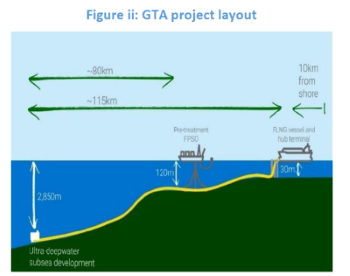
The GTA project will produce gas from an ultra-deepwater subsea system through floating production, storage and offloading (FPSO) vessel, which will act as a gas processing facility with a capacity of 5.2 bcma. Notably, May 2024 saw the arrival of the GTA FPSO, which is now moored 45 km offshore, marking the final step towards the production startup in Q4 2024.
The produced gas will be transferred to a floating liquefied natural gas (FLNG) facility at a nearshore area (Figure ii). In February 2019, BP signed a 20-year lease and operating agreement with Golar LNG for the Gimi FLNG vessel, designated as the LNG production facility for the GTA Phase 1 LNG project. The Gimi FLNG vessel, with a capacity of 2.5 Mtpa, arrived at the project site in February 2024. By the commencement of first gas in Q4 2024, Senegal will join the club of LNG exporters.
Source: Journal of Petroleum Technology Source: BP
Plans for expanding the GTA LNG project in the medium-term are underway. The GTA Phase 2 LNG project is expected to add 2.5-3 Mtpa of liquefaction capacity, with an FID anticipated in the short term. Discussions are currently ongoing with project partners and the governments of Senegal and Mauritania. Additionally, the GTA LNG project has the potential to expand further to 10 Mtpa in subsequent phases over the long term.
Senegal has even a greater potential to increase its share on the global gas market, with the development of other major projects, in particular in the Yakaar-Teranga (YT) area. The first exploration success was achieved there in 2016, and recoverable gas resources are estimated at around 600 bcm. Within this project, PETROSEN and its partner Kosmos are working closely with the Government of Senegal on an innovative development concept that prioritizes cost-competitive gas to the rapidly growing domestic market, combined with a liquefied natural gas (LNG) facility targeting exports into international markets.
The currently envisioned concept is an offshore development producing daily 18 million cubic meters of gas, with 4.3 million cubic meters of domestic gas per day transported via pipeline to shore and 3 Mtpa of export volumes liquefied on a floating LNG vessel. The concept is now being optimized to best meet the domestic and international requirements, after which the project will move into front-end design and engineering (FEED) in order to get a Final Investment Decision (FID) by end of first quarter of 2025 (Q1 2025). PETROSEN and Kosmos are looking forward to advancing the project with new partners (technical, financial and commercial) in a simplified and aligned relationship, increasing PETROSEN’s expertise through knowledge and skills transfer, and providing economic, social, and environmental benefits to the people of Senegal.
With these upstream developments, Senegal will not only become a significant LNG exporter, but will also boost its domestic consumption. Gas demand is expected to robustly ramp up starting from 2024, driven by the start-up of gas production from the GTA project. Several major projects are set to be commissioned in the coming years. The first project is the construction of the gas-fired Cap des Biches combined-cycle power plant, with a capacity of 300 MW, scheduled to begin operations in 2024. Additionally, the planned conversion of the Sendou coal-fired power plant (125 MW capacity) and the Malicounda fuel oil-fired power plant (120 MW capacity) to run on natural gas will further boost domestic gas consumption. Moreover, in May 2024, the government of the Saint-Louis region announced plans to build a new gas-fired power plant with a capacity of 250 MW. These projects, aligned with Senegal’s 2035 strategy for accelerating sustainable development and economic growth will increase gas consumption to meet the country's growing energy needs and contribute to its pursuit of greater energy independence and improved energy efficiency.
Despite all these significant advancements in gas projects, Senegal remains underexplored, presenting a substantial opportunity for further discoveries. Recent oil and gas findings, over the past decade, have confirmed the presence of significant reserves, highlighting the untapped potential within the two dozen available oilfield blocks. The political stability and commitment to economic growth provide a secure environment for long-term investments, making it a prime destination for oil and gas investors. The strategic location of the country further enhances its attractiveness as an investment destination.
Senegal, now the eighth African country to be a member of the GECF, faces challenges and opportunities like those of other African nations. In Africa, exploitation of natural gas resources may boost socio-economic development through exports revenues and industrialisation opportunities in conjunction with other natural resources embedded by the continent. In particular, natural gas may foster rapid increase of access to electricity and LPG, and sharply reduce energy poverty while ensuring environmental protection. In the meantime, realising this potential requires significant investment in gas infrastructure, particularly intra-regional gas pipelines, to support domestic and regional gas consumption.
In this context, the Forum continues providing unwavering support for African countries in their resolute pursuit of developing their gas resources. At the 7th GECF Summit, held on March 2, 2024 in Algeria, the Heads of State and Government of the GECF Member Countries expressed their “strong support for African countries in their aspirations and commendable endeavours to tackle energy poverty, address the challenges related to energy access and foster sustainable, equitable and inclusive socio-economic development while protecting the environment, in line with the United Nations 2030 Development Agenda and the African Union’s Agenda 2063.”
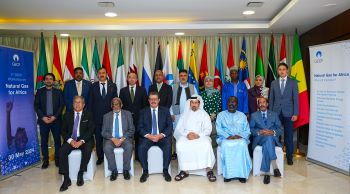
Furthermore, the GECF held its inaugural workshop themed “Natural Gas for Africa” on May 30, 2024, in commemoration of Africa Day. H.E. Eng. Mohamed Hamel, Secretary General of the GECF, highlighted the vast potential of the continent's natural resources to ensure energy and food security (Figure iv). In his opening remarks, he stated, “Available, clean, affordable, flexible and versatile, natural gas emerges as the fuel of choice for Africa … The share of natural gas in the African energy mix increased from 10% in 2000 to a significant 16% in 2022, and is projected to steadily rise to 21% in 2050. The demand is expected to reach 400 billion cubic meters, a significant increase from the level of 165 bcm in 2022.”
The GECF extends its warmest wishes for success to its new member, the Republic of Senegal.