Over the past few decades, the global electricity market has undergone profound transformations, driven by the accelerated transition to renewable energy in certain regions. Wind and solar power have emerged as key players, securing a significant foothold in the energy landscape. Between 2000 and 2024, global electricity generation doubled, rising from 15,500 TWh to 30,500 TWh. In the meantime, wind power output surged from 31 TWh to 2,400 TWh, while solar generation skyrocketed from just 1 TWh to 2,100 TWh. As a result, the combined share of wind and solar in global electricity generation grew from near zero to 8% and 7%, respectively, underscoring their expanding role in the energy transition. These renewable sources have primarily gained market share at the expense of fossil fuels, particularly coal and oil, whose shares declined from 38% to 35% and from 8% to 3%, respectively. Meanwhile, natural gas saw an increase in its share, rising from 18% to 23%, reflecting its role as a flexible and lower-emission energy source.
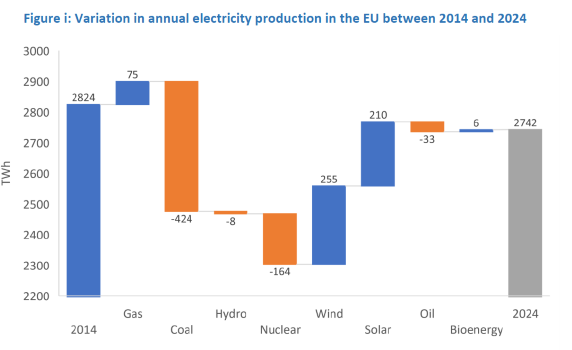
In the EU, wind and solar power have rapidly become the backbone of the region's electricity output. Between 2014 and 2024, they experienced exponential growth, with wind power increasing by 255 TWh and solar by 210 TWh, while coal-fired generation declined by 424 TWh (Figure i). As a result, the combined share of wind and solar in the EU’s electricity mix reached 28.5% (wind 17.5%, solar 11%), coming close to the 29% share of fossil fuels.
Source: GECF Secretariat based on data from Ember
As the EU's reliance on wind and solar energy continues to grow, the region must address two key challenges related to the variability of non-hydro renewable power generation, which, despite sharing a common origin, differ in nature and duration.
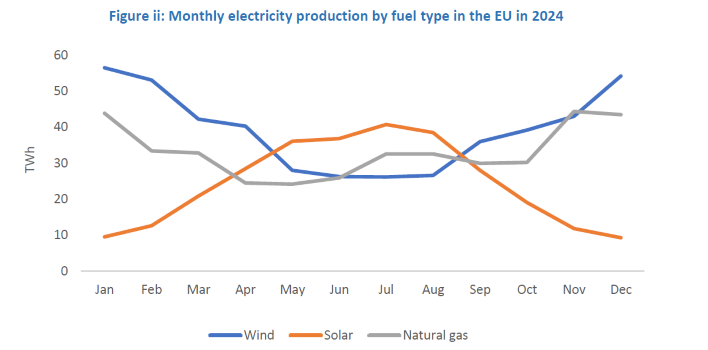
The first challenge is the inherent intermittency of wind and solar energy — a regular and predictable phenomenon driven by natural daily and seasonal cycles, as well as typical weather variations. Examples include the day/night cycle affecting solar power and the winter/summer cycle influencing both wind and solar generation, leading to consistent and foreseeable fluctuations in renewable energy output. Notably, summer experiences peak solar generation but reduced wind output due to dominant high-pressure systems (anticyclones), which create calmer, more stable weather with lower wind speeds. In contrast, winter sees maximum wind generation but minimal solar output due to shorter daylight hours and lower sun angles. For instance, in December, solar electricity output is four times lower than in July, while wind electricity output is twice as high (Figure ii).
Source: GECF Secretariat based on data from Ember
The second challenge is Dunkelflaute — a German term describing a meteorological phenomenon marked by irregular, and unpredictable periods of low wind speeds combined with limited sunlight. This typically occurs due to high-pressure weather systems (anticyclones), which create stable atmospheric conditions with weak winds and extensive cloud cover. The duration of Dunkelflaute can vary, lasting from a few days to several weeks, depending on prevailing weather patterns. The geographical extent of Dunkelflaute further compounds the challenge. Since northern and western Europe are heavily dependent on wind power, these events can simultaneously affect multiple countries, limiting the effectiveness of cross-border electricity trade as a mitigation strategy. Additionally, climate change may impact the frequency and severity of Dunkelflaute, as shifting weather patterns could lead to more frequent or prolonged anticyclones, increasing the risk of extended periods of low renewable generation.
Dunkelflaute typically results in extended lulls in wind and solar generation, significantly lowering the utilization rate of installed capacity. During such events, wind and solar output can drop to below 10% of their installed capacity for several consecutive days — compared to typical utilization rates of 20–50% for wind and 10–25% for solar under normal conditions. With both wind and solar generation severely constrained, the shortfall in renewable electricity supply can become critical, leaving a substantial gap between demand and available power. Ensuring energy security during these periods requires a combination of robust solutions, including the expansion of energy storage, enhancement of grid flexibility, and the development of reliable backup power sources.
During the winter season, Dunkelflaute poses an even greater challenge to the stability of the EU electricity grid, as electricity demand rises sharply compared to other seasons. In January 2025, regional electricity demand reached 247 TWh, up from 197 TWh in June 2024. This seasonal surge is driven by two key factors. First, shorter daylight hours increase lighting demand across residential, commercial, and public spaces. Second, colder temperatures lead to higher consumption of electric heating, including from heat pumps, which are central to the EU's decarbonization strategy—especially in countries with limited access to gas heating. With solar electricity output at its seasonal minimum and wind generation significantly reduced, Dunkelflaute disrupts the electricity grid and intensifies reliance on backup power sources.
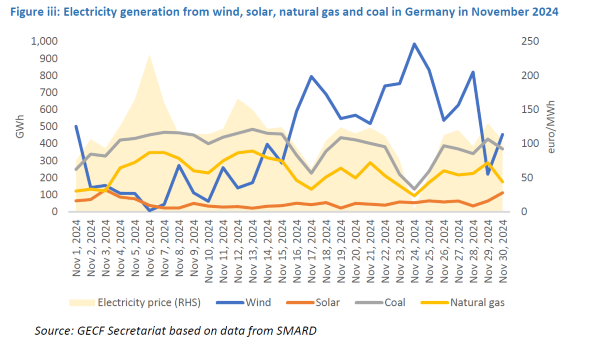
Germany’s electricity market, which contributes 18% of the EU's total electricity output, provides a clear example of how Dunkelflaute impacts energy production. Wind and solar together make up more than 40% of the country’s electricity mix (26% from wind and 14% from solar), while natural gas contributes 16%. We examine developments in Germany's electricity market in November 2024. Starting on November 2, wind power generation began to drop due to Dunkelflaute, reaching nearly zero on November 6, and remained well below the monthly average until November 13.
During this period, Germany had to rely heavily on backup power sources to compensate for the shortfall in wind generation. While hydro and biomass are important in the German electricity mix, they are primarily used for baseload power generation and cannot effectively serve as backup during Dunkelflaute due to their limited capacity and operational constraints. Similarly, nuclear and fuel oil in some other countries cannot provide the flexibility needed. As a result, natural gas and coal were the primary dispatchable energy sources, with gas-fired and coal-fired power generation increasing sharply to offset the loss of wind energy (Figure iii). Additionally, even beyond Dunkelflaute periods, wind generation remains reliant on backup power sources due to its regular intermittency. This is evident from the correlation between wind generation and gas-fired electricity production from November 17 to 28.