The COP28 UN Climate Change Conference was convened from 30 November to 13 December 2023 in Dubai, the United Arab Emirates, a distinguished GECF member country. With some 85,000 participants from 197 countries and more than 150 Heads of State and Government, the event was by far the largest UN climate change conference to date. One of the most significant outcomes of COP28 was the inauguration of the Global Stocktake (GST), a pivotal element outlined in Article 14 of the 2015 Paris Agreement. The GST serves as a comprehensive global assessment, gauging the progress made in addressing climate change and identifying the remaining challenges. The decision titled “Outcome of the first global stocktake” was adopted. Some elements of this document are of the utmost importance to the natural gas industry, in particular items 28 and 29. In item 28, the Parties recognize “the need for deep, rapid and sustained reductions in greenhouse gas emissions in line with 1.5 °C pathways”.
In this context, the decision calls on Parties to contribute to the following global efforts, in a nationally determined manner, taking into account the Paris Agreement and their different national circumstances, pathways and approaches. It is clear that the bottom-up approach underpinning the Paris Agreement is fully respected as well as the nationally determined character of any contribution. Various global efforts may, directly or indirectly, influence gas markets. First, "transitioning away from fossil fuels in the energy systems in a just, orderly, and equitable manner, accelerating action in this critical decade, so as to achieve net zero by 2050 in keeping with the science" stands out. There was a vigorous debate on the path forward to achieve climate goals, with a heightened emphasis on addressing the role of fossil fuels in the global energy mix. In this context, abandoning the wordings like “phasing-out or phasing-down of fossil fuels” in favor of the approved wordings “transitioning away from fossil fuels” could be considered as a positive signal for the gas industry, aimed at efficiently resolving the energy trilemma challenge rather than deliberately eliminating specific energy sources from the global mix. There is an understanding that there is no singular solution, underscoring the need for a diverse array of energy sources and technologies to collectively meet global climate goals. Second, a focus on “accelerating zero- and low-emission technologies, including, inter alia, renewables, nuclear, abatement and removal technologies such as carbon capture and utilization and storage, particularly in hard-to-abate sectors, and low-carbon hydrogen production” opens bright perspectives for advancing new technologies, such as CCUS and blue hydrogen, in the natural gas industry. Third, “accelerating efforts towards the phase-down of unabated coal power” paves the way for the accelerated development of coal-to-gas switching on the global level. In item 29, the Parties recognize that “transitional fuels can play a role in facilitating the energy transition while ensuring energy security”. Natural gas is considered as one of the most efficient and widely accepted transitional fuel. In this context, even an emphasis on “tripling renewable energy capacity globally by 2030” is a positive signal to the gas industry, since natural gas is a perfect backup energy source for renewables, notable for its intermittency.
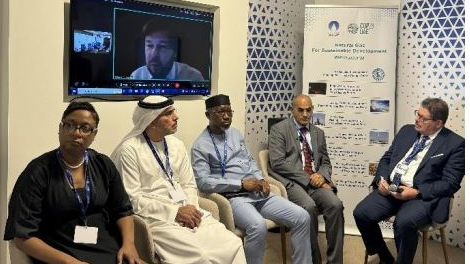
Moreover, item 154 states that “measures taken to combat climate change, including unilateral ones, should not constitute a means of arbitrary or unjustifiable discrimination or a disguised restriction on international trade”. This item was a response to requests from developing countries to address trade-related unilateral measures such as the EU's Carbon Border Adjustment Measures (CBAM). The GECF served as an advocate for the voice of natural gas at COP28. The GECF Secretary General, HE Eng Mohamed Hamel delivered a statement at the event, emphasizing the need "to support financing for natural gas projects and the scaling-up of cleaner technologies, such as carbon capture, utilization, and storage (Figure 1). This is crucial for a just, inclusive, and orderly energy transitions that satisfy the need for sustainable development, energy security, and energy affordability." Moreover, several workshops were held at the GECF Pavilion for industry experts to exchange views on key topics, including the role of natural gas in sustainable development, coal-to-gas switching, innovation in the gas industry, partnership between renewables and gas, clean cooking, and energy transition solutions.
Figure 1: GECF participation in COP28
Source: GECF Secretariat
The highly anticipated COP29 will be held on 11-22 November 2024, in another GECF member country, Azerbaijan, marking the third consecutive COP to be hosted by one of our distinguished member countries.